Free, open-source Flutter templates can dramatically speed up app development, whether you’re building a production product or experimenting with a side project to sharpen your skills. Some templates come with core flows, navigation, backend hooks, and architectural patterns already in place, which can save significant time but also shape how the rest of your app evolves. Others focus mainly on UI, giving you a polished starting point while leaving more room to apply your preferred state management approach, project structure, and backend setup. The best choice depends on what you need: ready-made functionality, architectural flexibility, or a balance between the two.
If you’re still evaluating those tradeoffs, these LogRocket guides on Flutter architecture, the BLoC pattern, GetX, Provider vs. Riverpod, and Firebase Authentication can help you choose a template that matches how you want to build.
Here is a curated list of the best free and open-source Flutter templates that you can use to create ecommerce, finance, social, dashboard, productivity, and entertainment apps:
🚀 Sign up for The Replay newsletter
The Replay is a weekly newsletter for dev and engineering leaders.
Delivered once a week, it’s your curated guide to the most important conversations around frontend dev, emerging AI tools, and the state of modern software.
Flutter ecommerce app templates
1. Shope: A minimalist, modern, complete online store
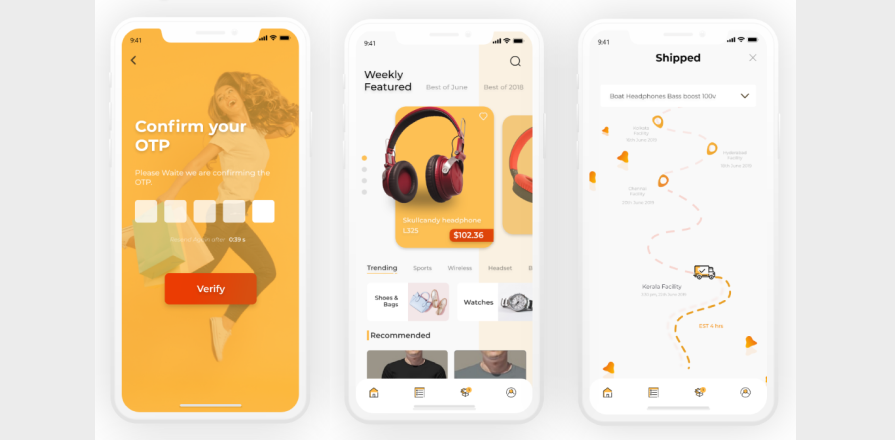
The Shope ecommerce template offers 38 pre-designed, minimal, modern, easily-customizable screens for building any online ecommerce store. This template includes app assets and already implements navigation and setup action handlers, so you can easily get started and customize for your exact requirements.
Highlighted features
- Complete pre-designed screens for a general ecommerce app, including authentication, registration, onboarding, settings, and browsing products
- Modern minimalist design with well-thought-out UX
- Includes screens for a digital wallet and tracking details for building feature-rich ecommerce apps
Development details summary
| Development detail | Summary |
|---|---|
| Code quality and production-readiness | Well-structured Dart code. UI is decomposed into screens and reusable components. Suitable for creating production apps |
| Device layout target | Mobile-focused design |
| State management | Basic with setState() |
| App logic and navigation | Only navigation implemented, but handlers created for actions |
| Backend implementation/integration | No |
| Auth services implementation | No |
| Testing integration | No tests included |
| UI/UX philosophy | Minimalist with maximalist features |
| Open-source license | MIT |
| Minimum supported SDK versions | Flutter: 3.7<br>Dart: 2.19 |
2. Ecommerce App: A minimal ecommerce store template
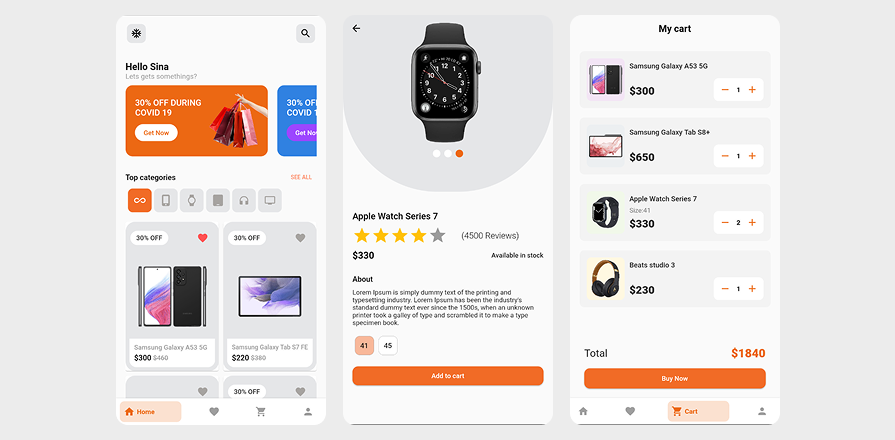
The Ecommerce App template is a minimal, modern ecommerce app template that offers pre-designed home, product list, product details, favorite products, and profile screens. Its simple structure and minimal UI code offer flexibility to extend it for any ecommerce solution.
Highlighted features
- A basic, foundational template with home, product list, and product details screens, like those found in general ecommerce apps
- A modern, clean, and productive UI/UX design inspired by a Dribbble project
- Includes a modern, attractive product list-to-details transition animation and navigation transitions
Development details summary
| Development detail | Summary |
|---|---|
| Code quality and production-readiness | Well-structured Dart code using the MVC design pattern and screen-widget code decomposition. Suitable as a foundation for a production app |
| Device layout target | Mobile-focused design |
| State management | GetX |
| App logic and navigation | Navigation, animations, and basic app logic included |
| Backend implementation/integration | No |
| Auth services implementation | No |
| Testing integration | No tests included |
| UI/UX philosophy | Minimalist with maximalist features |
| Open-source license | BSD 2 Clause License |
| Minimum supported SDK versions | Flutter: 3.18<br>Dart: 3.6 |
3. Grocery Plus: An online grocery store template
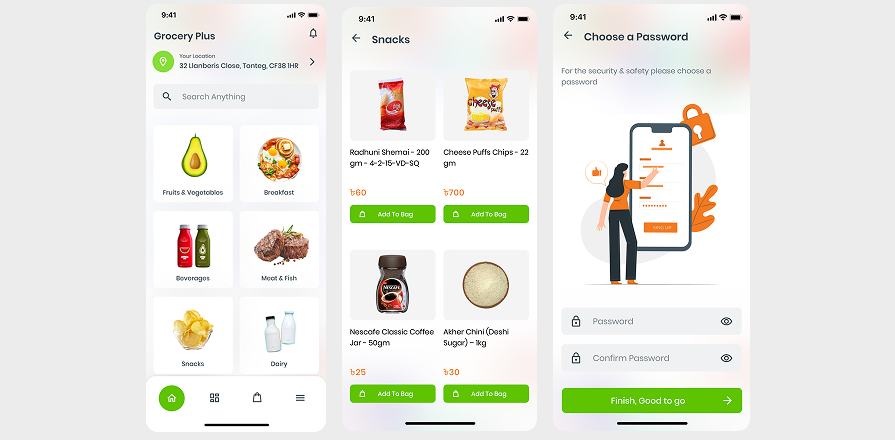
The Grocery Plus ecommerce template offers a complete, localization-configured starter codebase for an online grocery shop. It includes a product browser, product details, registration, and order management-like general ecommerce store features with grocery shopping-focused UX.
Highlighted features
- Complete, localization-enabled screens, including registration, product browser, product details, wishlist, cart, payment, and more
- Grocery-shopping-focused design, but it can be easily adjusted for other ecommerce apps, i.e., an electronics store
Development details summary
| Development detail | Summary |
|---|---|
| Code quality and production-readiness | Well-structured project using the Flutter clean architecture and MVC design patterns. Localization is already configured, but some code formatting improvements should be done before using it for a production app |
| Device layout target | Mobile-focused design |
| State management | GetX |
| App logic and navigation | Navigation and basic app logic included |
| Backend implementation/integration | No |
| Auth services implementation | No |
| Testing integration | No tests included |
| UI/UX philosophy | Minimalist with maximalist features |
| Open-source license | MIT |
| Minimum supported SDK versions | Flutter: 2.0<br>Dart: 2.12 |
Flutter finance app templates
4. FinTracker: A fully-functional expense tracker app
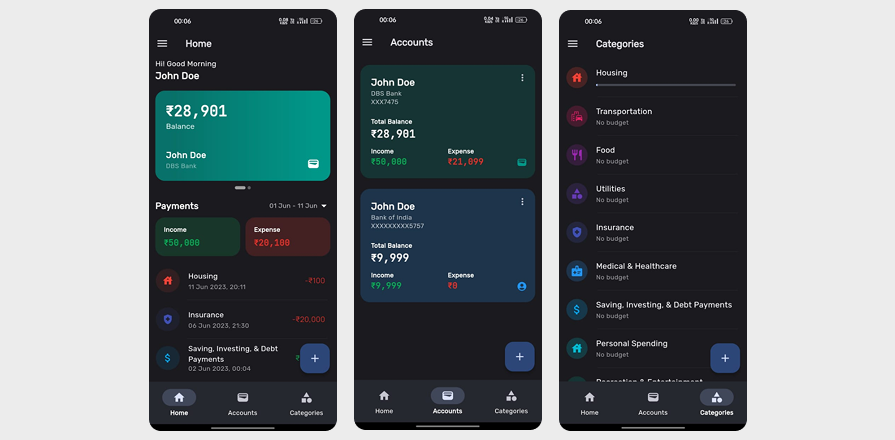
The FinTracker app template offers a fully functional codebase for a personal budget management app. It delivers a productive, user-friendly, modern UI/UX and offers basic budgeting features with pre-developed offline storage, allowing users to track expenses across categories and manage multiple financial accounts.
Highlighted features
- Pre-developed four main screens: home, accounts, categories, and settings
- Basic but easily extendable app structure that helps you build advanced, fully-featured financial apps
- Well-thought-out UI/UX design under minimalist and futuristic design concepts
Development details summary
| Development detail | Summary |
|---|---|
| Code quality and production-readiness | Well-structured codebase using a good screen-widget code arrangement strategy, also with suitable design patterns like DAO (Data Access Object). Suitable for creating production-grade apps |
| Device layout target | Mobile-focused design |
| State management | BLoC, using Cubit |
| App logic and navigation | Fully-functional app with complete implementation |
| Backend implementation/integration | Yes (SQLite) |
| Auth services implementation | No |
| Testing integration | No tests included |
| UI/UX philosophy | Minimalist with futuristic design features (e.g., neon colors) |
| Open-source license | MIT |
| Minimum supported SDK versions | Flutter: 3.18<br>Dart: 3.3 |
5. Crypto App: A cryptocurrency monitoring app template
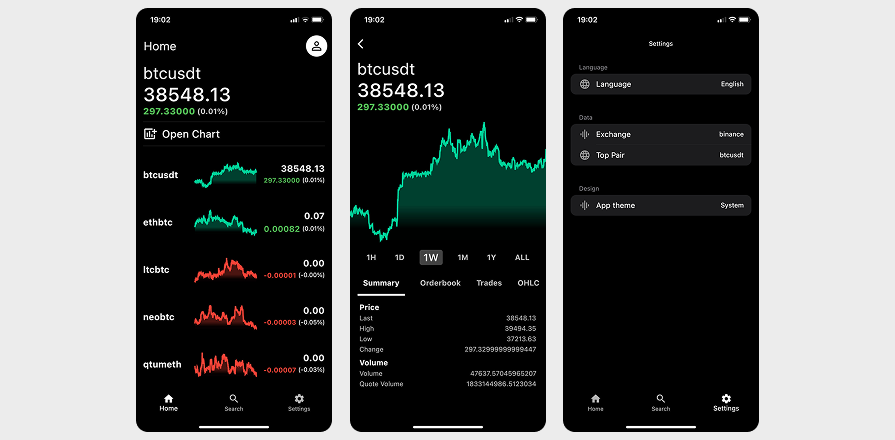
The CryptoApp template offers a fully functional cryptocurrency exchange monitoring app that includes features like an exchange summary dashboard, per-cryptocurrency-pair overview, and OHLC (Open-High-Low-Close) graph view.
Highlighted features
- Pre-developed screens with REST API (CryptoWatch) integration: home dashboard, cryptocurrency summary with graphs, cryptocurrency search, and settings page
- OHLC graph and other mandatory insights about the selected cryptocurrency pair
Development details summary
| Development detail | Summary |
|---|---|
| Code quality and production-readiness | Uses well-organized source files that use suitable code decomposition techniques. Improves maintainability with repository, provider, and other Dart coding practices. Suitable for production-grade apps |
| Device layout target | Mobile-focused design |
| State management | Riverpod with Hooks |
| App logic and navigation | Fully-functional app with complete implementation |
| Backend implementation/integration | Yes (a third-party REST API) |
| Auth services implementation | No |
| Testing integration | API tests included |
| UI/UX philosophy | Futuristic design (e.g., neon colors) with enterprise design concepts |
| Open-source license | MIT |
| Minimum supported SDK versions | Flutter: 2.0<br>Dart: 2.12 |
6. Crypto Wallet: A cryptocurrency wallet app template
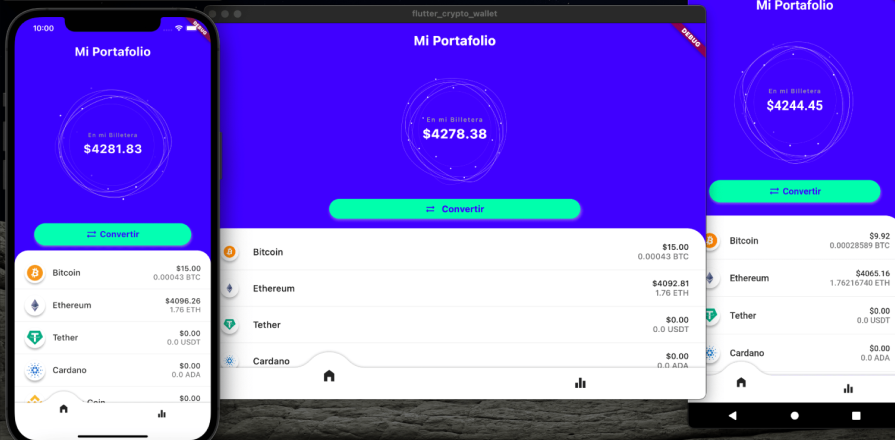
The Crypto Wallet template has pre-designed, minimal screens for creating crypto wallet apps across multiple device types. It also includes REST API integration that turns the UI template into a demo wallet app with real exchange rates. It includes screens for basic wallet features like dashboard, personal portfolio, and conversion.
Highlighted features
- Pre-designed minimal screens with actual exchange rate details and animations: home, cryptocurrency list with real exchange rates, personal portfolio, and conversion
- Responsive layout that shows different app versions for mobile and desktop devices
Development details summary
| Development detail | Summary |
|---|---|
| Code quality and production-readiness | Well-structured project using the Flutter clean architecture and general design patterns like DTO (Data Transfer Object). Suitable as a UI template for production apps since API integration is used only for demonstration purposes |
| Device layout target | Mobile and desktop-focused responsive design |
| State management | Riverpod with StateNotifier |
| App logic and navigation | A UI template extended with API integration. Includes demo app logic and navigation implementation |
| Backend implementation/integration | Yes (only for exchange rates using a third-party REST API) |
| Auth services implementation | No |
| Testing integration | No tests included |
| UI/UX philosophy | Minimalistic, clean design with maximalist colors |
| Open-source license | MIT |
| Minimum supported SDK versions | Flutter: 2.2<br>Dart: 2.12 |
7. Mobile Banking: A basic mobile banking app template
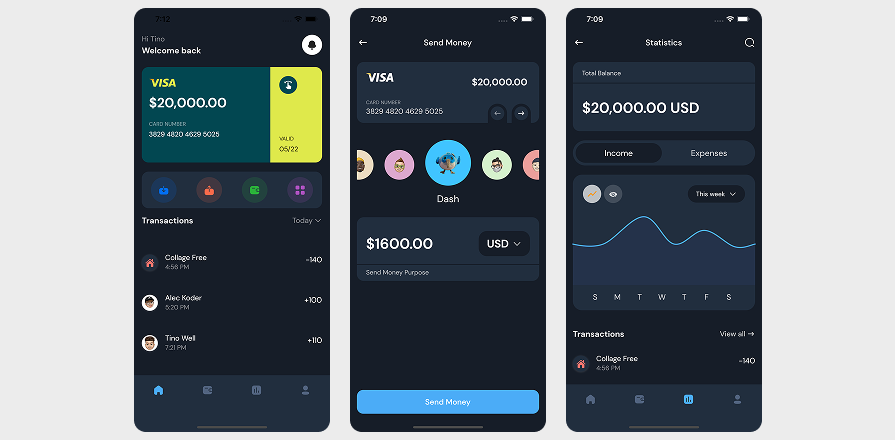
The Mobile Banking template offers a good starter project for creating a modern mobile banking app with several essential pre-designed pages. This template is inspired by a Dribbble project that focuses on improving financial app UX with simplicity and modern UI design principles.
Highlighted features
- Simple pre-designed screens that put a foundation for your financial product: homepage, payment card management, sending money, profile page, and account statistics
- Minimal, futuristic UI/UX design with easily customizable UI source
Development details summary
| Development detail | Summary |
|---|---|
| Code quality and production-readiness | The source code is structured with good MVVM (Model-View-ViewModel) widget decomposition, also with some general patterns like the repository pattern. However, a code refactoring may be needed before using it for production-grade app development |
| Device layout target | Mobile-focused design |
| State management | Provider and setState() |
| App logic and navigation | Includes navigation implementation |
| Backend implementation/integration | No |
| Auth services implementation | No |
| Testing integration | No tests included |
| UI/UX philosophy | Minimalistic, clean design with maximalist and futuristic features (neon colors, maximalist colors, and creative avatars) |
| Open-source license | MIT |
| Minimum supported SDK versions | Flutter: 2.5<br>Dart: 2.14 |
Flutter social app templates
8. SocialMediaApp – A minimal, modern social media app foundation
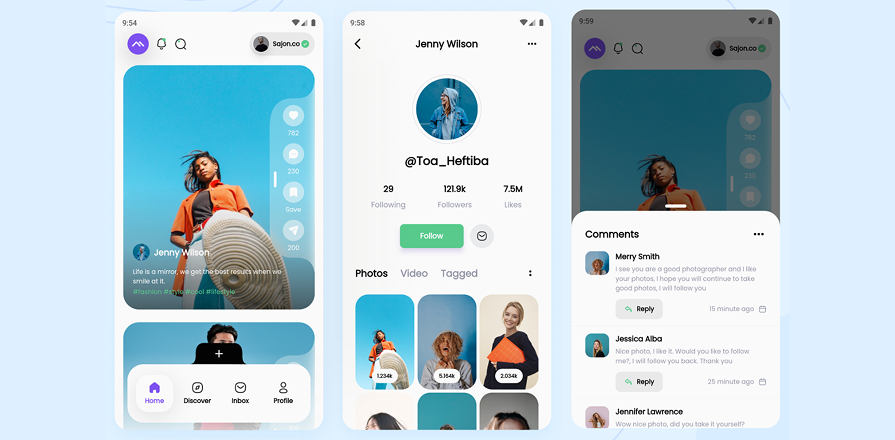
The SocialMediaApp template is a very minimal, highly customizable, and easily extensible template that consists of only two main pages. It is inspired by a Dribbble design that focuses on creating a good UX through modern, clean, and ultra-minimalistic design.
Highlighted features
- Ultra-minimalist design that puts a good foundation for a modern social media app with just two initial pages: home feed and profile
- Includes a pre-designed bottom-sheet comments segment that you can easily turn into a real comments section by integrating a data source
Development details summary
| Development detail | Summary |
|---|---|
| Code quality and production-readiness | Code is structured with good screen-widget decomposition and separates app logic from the UI code. Separates route and theme configuration for easy customization. Suitable for a production-grade app’s foundation |
| Device layout target | Mobile-focused design |
| State management | BLoC, using Cubit |
| App logic and navigation | Includes navigation implementation |
| Backend implementation/integration | No |
| Auth services implementation | No |
| Testing integration | No tests included |
| UI/UX philosophy | Modern ultra-minimalistic design with a calming neutral theme |
| Open-source license | MIT |
| Minimum supported SDK versions | Flutter: 3.0<br>Dart: 2.18 |
9. Moonbase: A complete, minimal forum app
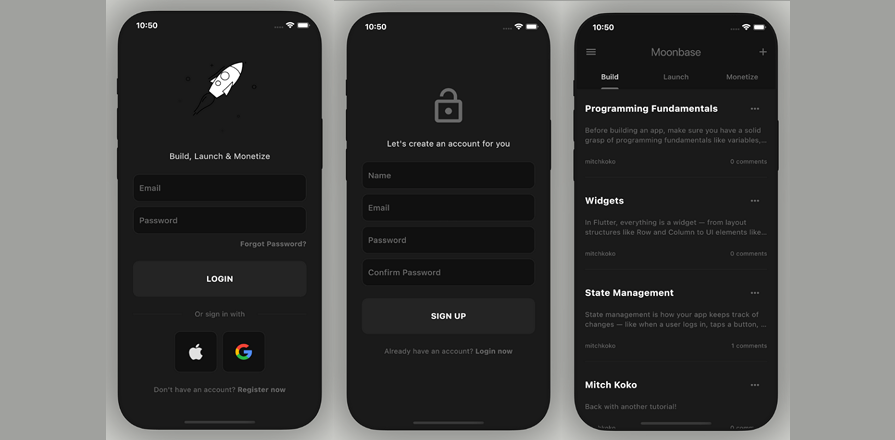
The Moonbase app template offers a complete codebase of a fully functional social media app with authentication implementation. It lets free users read posts and comments, and paid users create posts and add comments.
Highlighted features
- Minimal but complete implementation of a forum-like social media app with primary features, such as user authentication, reading/creating posts, and commenting.
- Monetization is pre-integrated using the RevenueCat service, and content moderation features are also included
Development details summary
| Development detail | Summary |
|---|---|
| Code quality and production-readiness | Well-structured project using the pure Flutter clean architecture. Suitable for creating production-grade apps |
| Device layout target | Mobile-focused design |
| State management | BLoC, using Cubit |
| App logic and navigation | A fully functional app with complete implementation |
| Backend implementation/integration | Yes (Firebase) |
| Auth services implementation | Yes (Password-based and SSO logins) |
| Testing integration | No tests included |
| UI/UX philosophy | Modern ultra-minimalistic design with a calming neutral theme |
| Open-source license | MIT |
| Minimum supported SDK versions | Flutter: 3.24<br>Dart: 3.5 |
10. Wooble: A fully-functional social media app
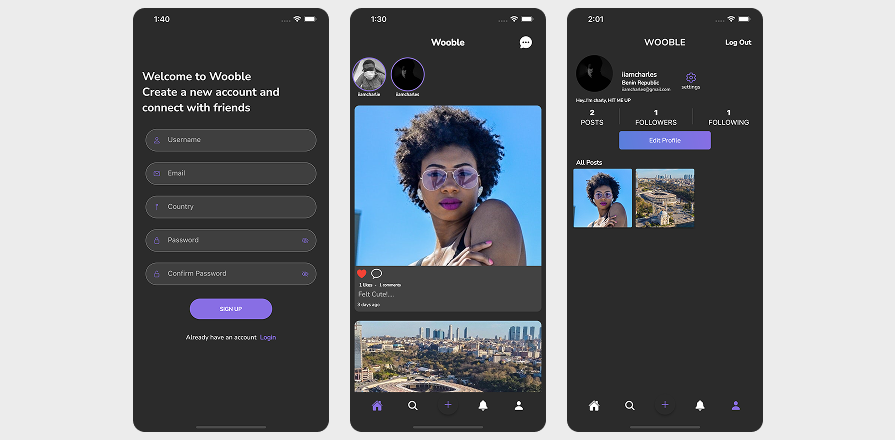
Wooble is a fully-functional social media app template that offers a fully-featured, complete social media app codebase that includes pre-developed features like photo feed, liking and commenting, user search, messaging, profile management, and more.
Highlighted features
- A complete, fully-functional app with main screens that a generic social media app has: feed, chats, profile, and onboarding
- Includes almost all features that a modern social media app has, from feed to stories
Development details summary
| Development detail | Summary |
|---|---|
| Code quality and production-readiness | Well-structured UI source code. Generally uses good design patterns for maintainability. However, the separation of the data layer through code refactoring is needed before production use |
| Device layout target | Mobile-focused design |
| State management | Provider |
| App logic and navigation | A fully functional app with complete implementation |
| Backend implementation/integration | Yes (Firebase) |
| Auth services implementation | Yes (Password-based login) |
| Testing integration | No tests included |
| UI/UX philosophy | Modern ultra-minimalistic design with a calming neutral theme |
| Open-source license | MIT |
| Minimum supported SDK versions | Flutter: 3.0<br>Dart: 2.17.6 |
11. SocialMediaAppUIKit: A complete social media app screens
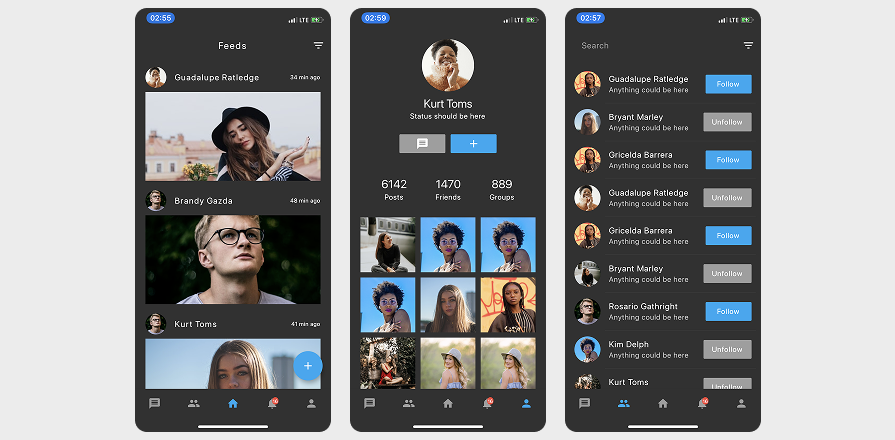
The SocialMediaAppUIKit template offers a complete social media UI template that includes designs for home feed, user search, messaging, notification panel, and profile management. It implements a basic UI theme, but you can easily modify it to adhere to your favorite UI/UX style.
Highlighted features
- Complete pre-designed screens for a general social media app, including home feed, users list, messaging threads, user profile, and login
- A basic template that you can extend as you wish to any UI/UX philosophy
Development details summary
| Development detail | Summary |
|---|---|
| Code quality and production-readiness | Well-structured UI source code with good screen-widget code decomposition. A UI refactoring may be needed before using it for a production app project |
| Device layout target | Mobile-focused design |
| State management | setState() |
| App logic and navigation | Includes navigation implementation |
| Backend implementation/integration | No |
| Auth services implementation | No |
| Testing integration | No tests included |
| UI/UX philosophy | Basic, minimal, neutral UI that is ready to adhere to any UI design philosophy |
| Open-source license | WTFPL |
| Minimum supported SDK versions | Flutter: 3.10<br>Dart: 3.0 |
Flutter dashboard app templates
12. Admin Panel: A complete dashboard UI template
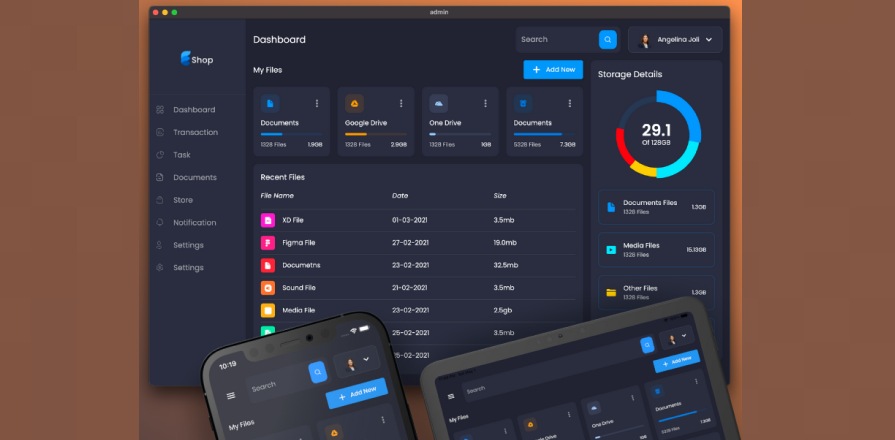
The Admin Panel template is a responsive, modern dashboard template that you can use to build a dashboard app or integrate into any Flutter app. This template creates a file-manager-focused design, but you can use those components for any design case by just changing labels and setting data sources.
Highlighted features
- A responsive design that shows different well-thought-out app versions on mobile, tablet, and desktop devices
- Modern, minimal UI design with several pre-designed reusable widgets: summary cards, table, and chart
Development details summary
| Development detail | Summary |
|---|---|
| Code quality and production-readiness | Well-structured UI source code with good screen-widget code decomposition and reusable dashboard widget management. Suitable as a foundation for a production-grade app |
| Device layout target | Mobile, tablet, and desktop-focused responsive design |
| State management | Provider |
| App logic and navigation | Includes navigation implementation |
| Backend implementation/integration | No |
| Auth services implementation | No |
| Testing integration | No tests included |
| UI/UX philosophy | Modern minimal design with maximalist colors |
| Open-source license | MIT |
| Minimum supported SDK versions | Flutter: 3.22<br>Dart: 3.5 |
13. FlareLine – A feature-rich admin dashboard
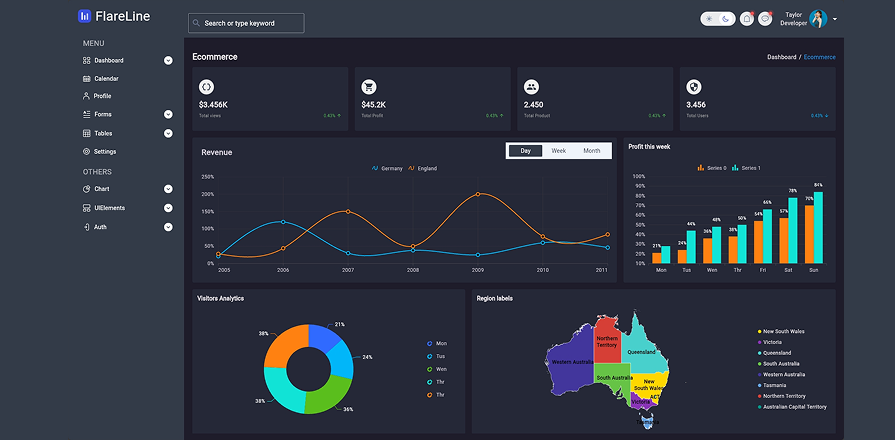
FlareLine is a responsive, modern, complete, feature-rich dashboard template that you can use to build any dashboard app or integrate into any Flutter app. This template creates a CRM-focused design, but you can use those components for any design case with minor adjustments and by setting up data sources.
Highlighted features
- A complete dashboard app with multiple pages that developers can use for creating various pages with a few adjustments
- A responsive design that shows different well-thought-out app versions on mobile and desktop devices
Development details summary
| Development detail | Summary |
|---|---|
| Code quality and production-readiness | Well-structured UI source code with good screen-widget code decomposition and reusable dashboard widget management. Localization is already configured. After adjusting it by removing unwanted features, suitable as a foundation for a production-grade app |
| Device layout target | Mobile and desktop-focused responsive design |
| State management | Provider |
| App logic and navigation | Includes navigation implementation |
| Backend implementation/integration | No |
| Auth services implementation | No |
| Testing integration | No tests included |
| UI/UX philosophy | Modern minimal design with faded maximalist colors |
| Open-source license | MIT |
| Minimum supported SDK versions | Flutter: 3.41<br>Dart: 3.4.1 |
14. Focus UI Kit: An admin dashboard-focused UI kit demo
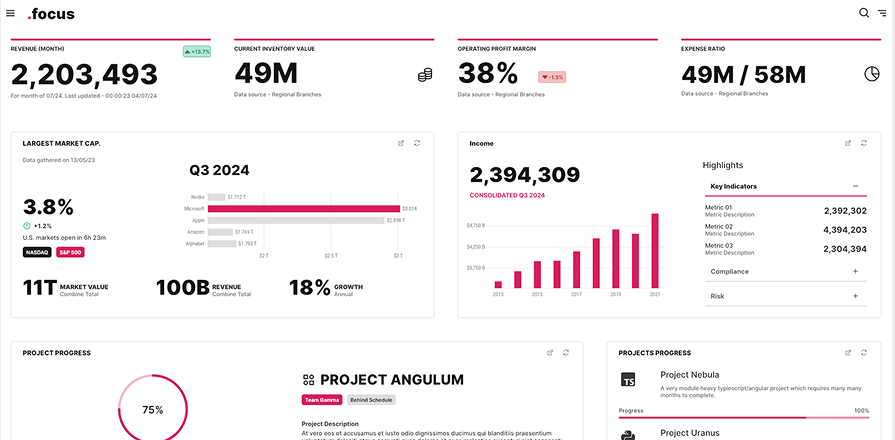
The Focus UI Kit project offers a fully-featured, complete UI kit for creating responsive Flutter apps from scratch. It includes a demo app that you can easily extend to build dashboard apps. The UI/UX design of this dashboard template is enterprise-app-friendly, but you can also use it with any modern app design with minor styling adjustments.
Highlighted features
- Offers many pre-designed widgets for creating everything from simple dashboards to advanced enterprise dashboards
- A responsive design that shows different well-thought-out app versions on mobile and desktop devices
Development details summary
| Development detail | Summary |
|---|---|
| Code quality and production-readiness | The UI Kit project uses a well-structured codebase with Flutter development best practices. The demo project is created for UI Kit demonstration purposes, but can be used to create a production-grade app after adjusting widget naming and code organization |
| Device layout target | Mobile and desktop-focused responsive design |
| State management | BLoC |
| App logic and navigation | Includes navigation implementation |
| Backend implementation/integration | No |
| Auth services implementation | No |
| Testing integration | No tests included |
| UI/UX philosophy | Enterprise-UX-friendly corporate design, but adjustable for different styles |
| Open-source license | MIT |
| Minimum supported SDK versions | Flutter: 3.27<br>Dart: 3.7 |
Flutter productivity app templates
15. Doable: A fully-functional, minimal, offline to-do app
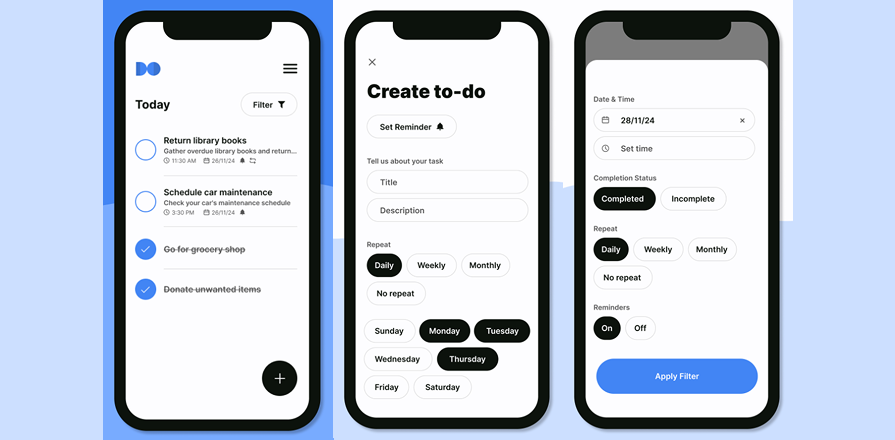
Doable is a fully functional offline to-do app template that you can easily customize and extend with advanced features. It adheres to a minimal, modern UI/UX design and implements features that a general task management app should have.
Highlighted features
- A fully-functional app with an offline storage implementation and general task management features, like simple task creation, scheduling tasks, filtering, and notifications
- Pre-developed, easily extendable screens: task list, task creation/modification, filtering, and settings
Development details summary
| Development detail | Summary |
|---|---|
| Code quality and production-readiness | Well-structured source code with good UI code decomposition techniques and general design patterns like DAO and repository patterns. Suitable for creating production-grade apps |
| Device layout target | Mobile-focused design |
| State management | setState() |
| App logic and navigation | A fully functional app with complete implementation |
| Backend implementation/integration | Yes (SQLite) |
| Auth services implementation | No |
| Testing integration | No tests included |
| UI/UX philosophy | Modern ultra-minimalistic design |
| Open-source license | MIT |
| Minimum supported SDK versions | Flutter: 3.35<br>Dart: 3.9 |
16. Taskez: A complete, modern productivity app template
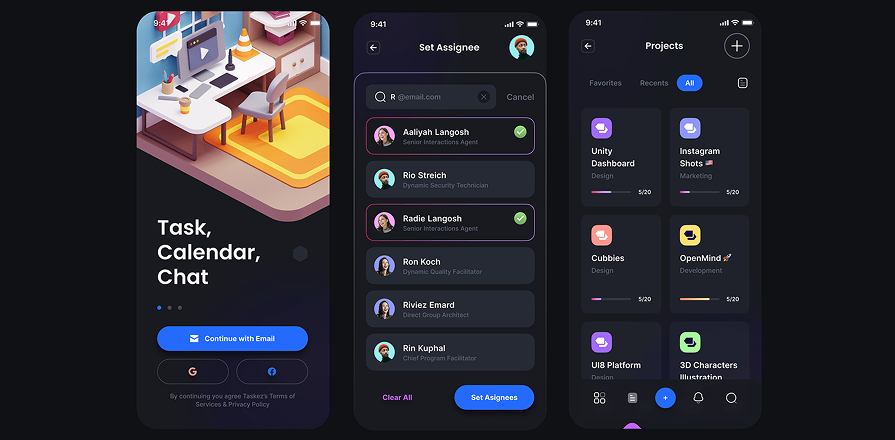
Taskez is a modern, collaborative productivity app template that includes features like project management, task management, messaging, and task scheduling. It offers unique, modern screens for creating everything from simple task management apps to advanced collaborative, feature-rich productivity platforms.
Highlighted features
- Pre-designed 52 screens: onboarding, plan selection, dashboard, tasks, projects, chat, settings, and more
- Modern UI/UX design with Flutter bottom sheets, so you can even extend this template with features without doing UI/UX-related upgrades
Development details summary
| Development detail | Summary |
|---|---|
| Code quality and production-readiness | Well-structured UI source code with good screen-widget code decomposition. It needs separate styling classes for styling isolation before use in a production-grade app |
| Device layout target | Mobile-focused design |
| State management | setState() |
| App logic and navigation | Includes navigation implementation |
| Backend implementation/integration | No |
| Auth services implementation | No |
| Testing integration | No tests included |
| UI/UX philosophy | Modern clean design with maximalist features (e.g., maximalist colors and imagery) |
| Open-source license | BSD 3 Clause |
| Minimum supported SDK versions | Flutter: 3.0<br>Dart: 2.18 |
17. Time Cop: a fully-functional, simple offline time tracking app
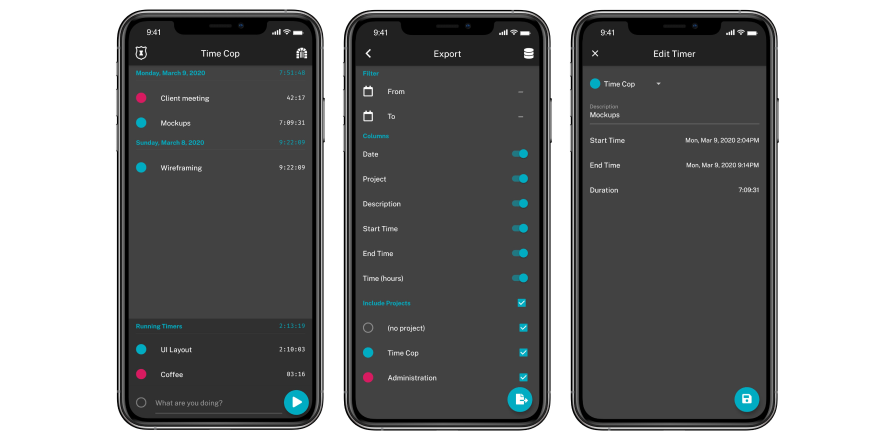
Time Cop is a fully functional, simple, offline time-tracking app. It lets users create multiple tasks under different projects and monitor time. It also supports exporting registered task timers into PDF and CSV files.
Highlighted features
- Pre-developed screens for basic time tracking features: projects list, timers, create/edit timer, export, and about app page
- Localization-enabled app with simple, ultra-minimal UI that you can easily customize
Development details summary
| Development detail | Summary |
|---|---|
| Code quality and production-readiness | Well-structured codebase using the Flutter BLoC pattern. Suitable as a foundation for a production-grade app |
| Device layout target | Mobile-focused design |
| State management | BLoC |
| App logic and navigation | A fully functional app with complete implementation |
| Backend implementation/integration | Yes (SQLite) |
| Auth services implementation | No |
| Testing integration | No tests included |
| UI/UX philosophy | Modern clean design with maximalist features (e.g., maximalist colors) |
| Open-source license | Apache 2.0 |
| Minimum supported SDK versions | Flutter: 3.16<br>Dart: 3.2 |
Flutter entertainment app templates
18. Cinema Ticket: A fully-functional movie booking app
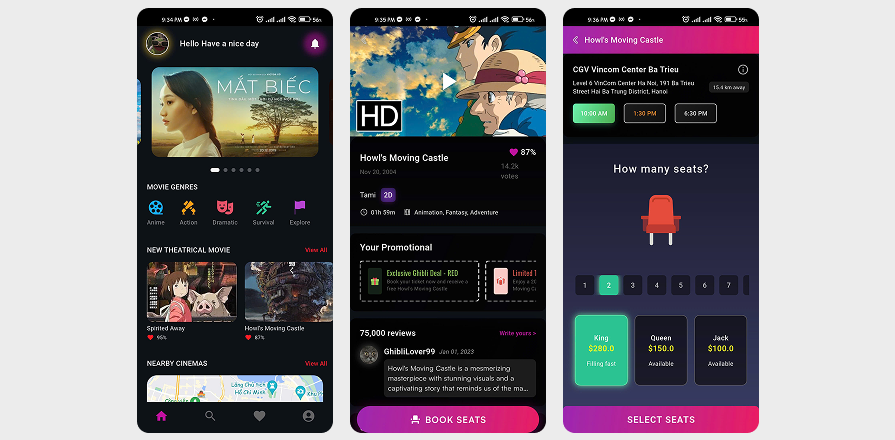
The Cinema Ticket template offers a complete codebase of a fully-functional movie booking app. It offers features like SSO login, browsing movies, and booking a time slot.
Highlighted features
- Implements primary movie booking features in several screens: onboarding, sign in, registration, movies list, movie details, time slot selection, seat selection, and tickets
- Uses a maximalist, entertainment-friendly, easily customizable UI implementation and renders different responsive app versions for mobile, tablet, and desktop devices
Development details summary
| Development detail | Summary |
|---|---|
| Code quality and production-readiness | Well-structured codebase using the Flutter BLoC pattern. Suitable as a foundation for a production-grade app |
| Device layout target | Mobile, tablet, and desktop-focused responsive design |
| State management | BLoC |
| App logic and navigation | A fully functional app with complete implementation |
| Backend implementation/integration | Yes (RESTful API) |
| Auth services implementation | Yes (password-based and SSO logins) |
| Testing integration | No tests included |
| UI/UX philosophy | Maximalist design |
| Open-source license | MIT |
| Minimum supported SDK versions | Flutter: 3.24<br>Dart: 3.7 |
19. Neumorphic Music Player: A minimal, fully-functional offline media player app
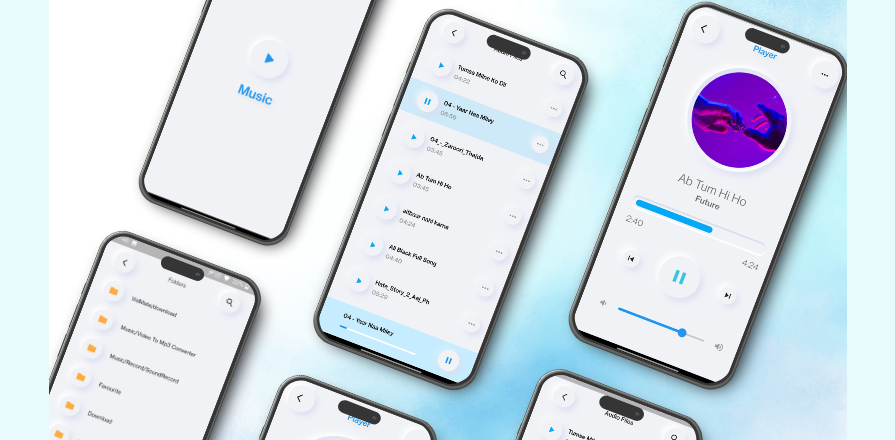
The Neumorphic Music Player template offers the codebase for a minimal but complete local music player. It creates retro-style UX with a neumorphic UI and also implements smooth animations.
Highlighted features
- Implements primary local music file playing features, including browsing local music files, creating an album, browsing the album, and basic player controls
- Supports a mini player under the playlist with play/pause and a main player view with all player features
Development details summary
| Development detail | Summary |
|---|---|
| Code quality and production-readiness | Well-structured Dart code using the MVC design pattern and good screen-widget code decomposition. Suitable as a foundation for a production app |
| Device layout target | Mobile-focused design |
| State management | GetX |
| App logic and navigation | A fully functional app with complete implementation |
| Backend implementation/integration | Yes |
| Auth services implementation | No |
| Testing integration | No tests included |
| UI/UX philosophy | Minimalist and neumorphic design |
| Open-source license | MIT |
| Minimum supported SDK versions | Flutter: 3.3<br>Dart: 3.0.2 |
20. MovieLab: A fully-functional movie tracker and finder
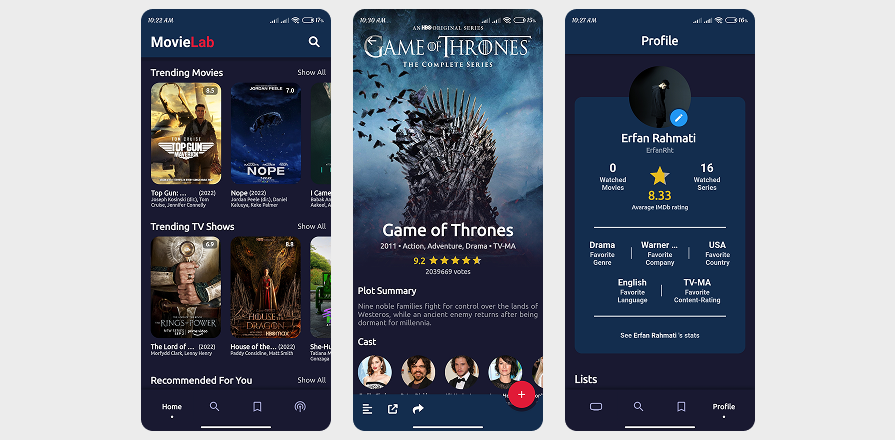
MovieLab is a movie finder and tracker app with features like browsing movies, reading movie star profiles, managing movie lists, and maintaining a movie enthusiast profile.
Highlighted features
- Pre-developed screens for primary movie browsing and tracking features: personalized homepage, movie list, movie details, movie star profile, watch history timeline, profile, and about page
- Easily customizable and extendable design with a modern, entertainment-friendly, but minimal UI
Development details summary
| Development detail | Summary |
|---|---|
| Code quality and production-readiness | Well-structured codebase with general code arrangement patterns that implements atomic reusable widgets. Suitable for creating production apps, but an initial refactoring is needed for developers who prefer BLoC or other modern Flutter development patterns |
| Device layout target | Mobile-focused design |
| State management | GetX |
| App logic and navigation | A fully functional app with complete implementation |
| Backend implementation/integration | Yes (IMDb API) |
| Auth services implementation | No |
| Testing integration | No tests included |
| UI/UX philosophy | Minimalist design with faded maximalist colors |
| Open-source license | Apache 2.0 |
| Minimum supported SDK versions | Flutter: 3.0<br>Dart: 2.17 |
Conclusion
We’ve gone through a curated list of free and open-source Flutter app templates available on GitHub. These templates use commercial-development-friendly, free open-source code licenses like MIT, Apache 2.0, BSD 3 Clause, and WTFPL, so you can freely use these templates for building hobby products and production-grade commercial products. Production-readiness of these templates is measured by evaluating the adherence to general development patterns, so make sure to adjust them according to your preferred Flutter coding practices before integrating them into your production app codebases.
You can use the whole template and extend it, use part of it, or create your own by getting inspiration from these free templates to build your next awesome Flutter app. You can also browse more free and open-source Flutter app repositories from this GitHub repository and use them as templates or start with the generic, minimal, boilerplate, like Flutter Starter.
Get set up with LogRocket’s modern error tracking in minutes:
-
Visit to get
an app ID -
Install LogRocket via npm or script tag.
LogRocket.init()must be called client-side, not
server-side$ npm i --save logrocket // Code: import LogRocket from 'logrocket'; LogRocket.init('app/id');// Add to your HTML: <script src=" <script>window.LogRocket && window.LogRocket.init('app/id');</script> - (Optional) Install plugins for deeper integrations with your stack:
- Redux middleware
- NgRx middleware
- Vuex plugin
Get started now
PakarPBN
A Private Blog Network (PBN) is a collection of websites that are controlled by a single individual or organization and used primarily to build backlinks to a “money site” in order to influence its ranking in search engines such as Google. The core idea behind a PBN is based on the importance of backlinks in Google’s ranking algorithm. Since Google views backlinks as signals of authority and trust, some website owners attempt to artificially create these signals through a controlled network of sites.
In a typical PBN setup, the owner acquires expired or aged domains that already have existing authority, backlinks, and history. These domains are rebuilt with new content and hosted separately, often using different IP addresses, hosting providers, themes, and ownership details to make them appear unrelated. Within the content published on these sites, links are strategically placed that point to the main website the owner wants to rank higher. By doing this, the owner attempts to pass link equity (also known as “link juice”) from the PBN sites to the target website.
The purpose of a PBN is to give the impression that the target website is naturally earning links from multiple independent sources. If done effectively, this can temporarily improve keyword rankings, increase organic visibility, and drive more traffic from search results.