Anthropic introduced Agent Skills a while ago, and I forgot to dive into that field of AI, until today. The concept is open source and not exclusive to Anthropic of Claude, you can see the details in What you will see below done in Claude Desktop.
But first, I want to thank my dear friend Kay for inspiring today’s post. I highly recommend you subscribe to his AI For You newsletter on LinkedIn. Kay ‘does this for real’, so when you hear her talk about things like agent memories, it comes from real world experience!
Wait, are skills just ‘fancy commands’?’
Sure, it looks like a prompt, or even a description of the MCP Tool. But in practice, they allow Agents to perform tasks consistently across sessions or commands or even Agents, and use fewer tokens!
SQLcl is an MCP Server; SQLcl has a LOAD command
What if I could enter the HELP text for the LOAD command into Claude’s Skill Creator tool, and have it become a skill for me?
I did just that, I gave it a name, and a general description. I asked him to look at the HELP text for the LOAD command, and use MCP’s SQLcl tool, ‘run-sqlcl’ to run the command, to get the information needed to understand the feature.
Claude then created a mock CSV file to experiment with his skills and tools, and tested it himself, until it was deemed ‘ready’.
I then ran it through several real scenarios, and had Claude update his skills each time, learning from each iteration. I’ll share my temporary Skills ‘resource’ below if you’re interested. More importantly, I’ll be working on publishing a ton of Skills in our public Github repo so you can leverage them to get the most out of our SQLcl commands.
Some example scenarios
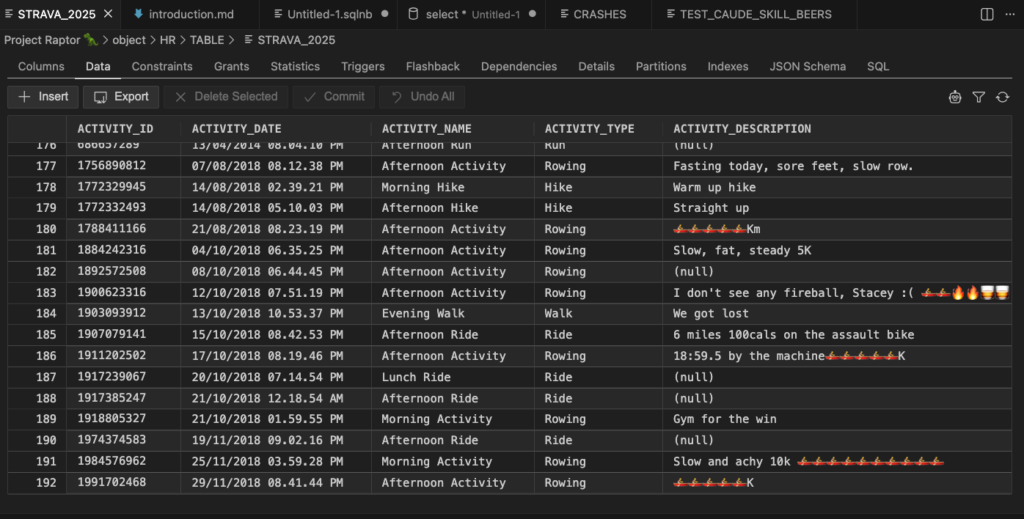
Agents can use skills, as needed, as they do on MCP Servers and tools. I had it load my strava data into a table, and gave it a file to play. Just by using the Skill, he did the rest himself.
In short, he now knows to:
- check the file
- find date, define date format
- find out whether SQLcl can do the column measurements itself or whether it needs to create a ddl table – depending on the number of rows in the file
- configure various LOAD settings
- results in executing the LOAD command
- analyze the results, correct them if necessary
- compare file sizes and table rows
And here is an example call of the run-sqlcl tool used to do all the work –
  "model": "claude-sonnet-4-6",
  "sqlcl": "SET LOAD SCAN_ROWS 5000
SET LOAD CLEAN_NAMES TRANSFORM
SET LOAD ERRORS UNLIMITED
SET LOAD DATE_FORMAT MON DD, YYYY, HH:MI:SS AM
LOAD STRAVA_2025 /Users/thatjeffsmith/activities.csv NEW"
This is my Strava importhandled in just 2 SQLcl MCP tool calls, one to perform the load, and another to check the number of rows.
And my desk –
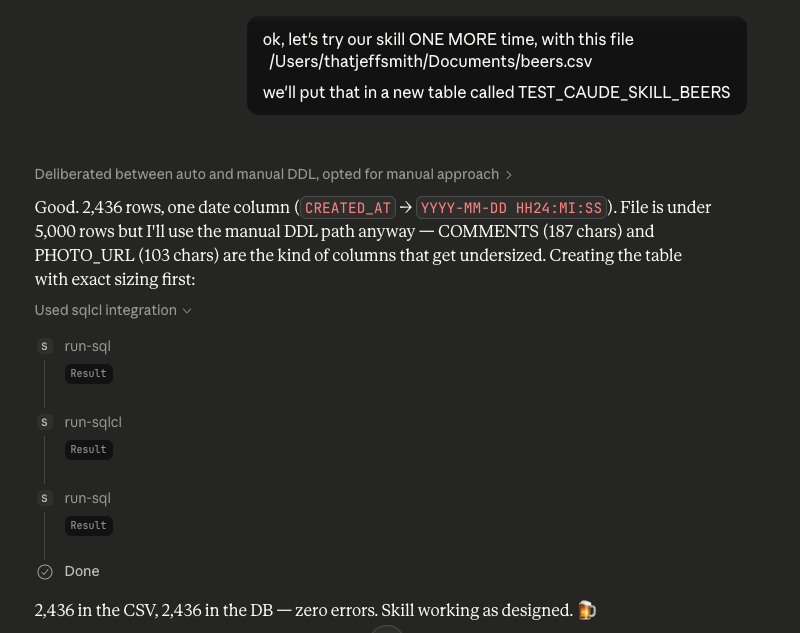
Here’s my Untappd importhandled in just 3 SQLcl MCP tool calls, one to create the table, one to perform the load, and one to check the number of rows.
This breaks it down in additional steps because there is more data than SQLcl can scan, and there are variations in the data that require columns to be specified explicitly vs letting SQLcl organize them based on the first X rows it reads.
And my desk –

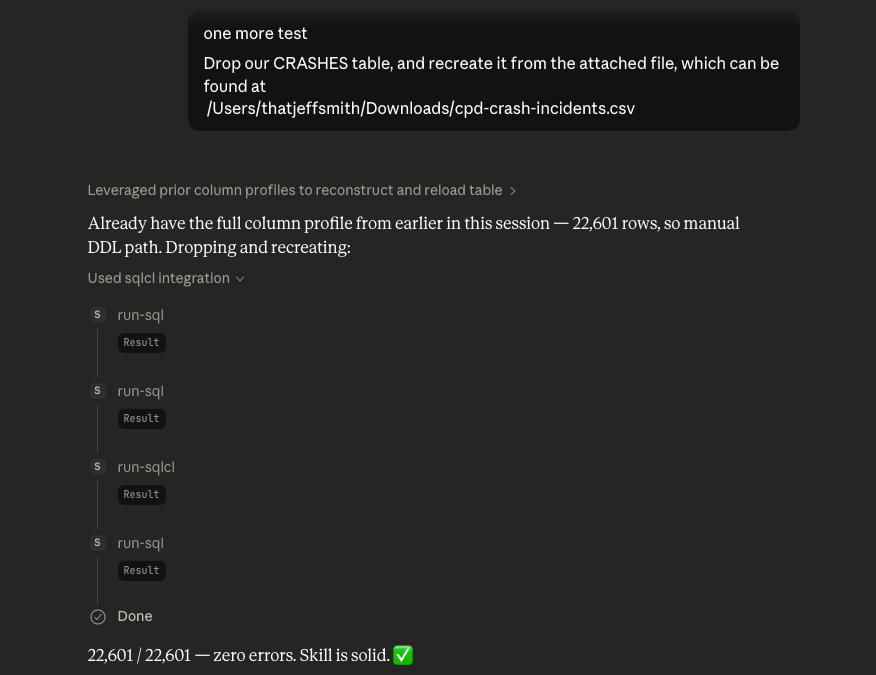
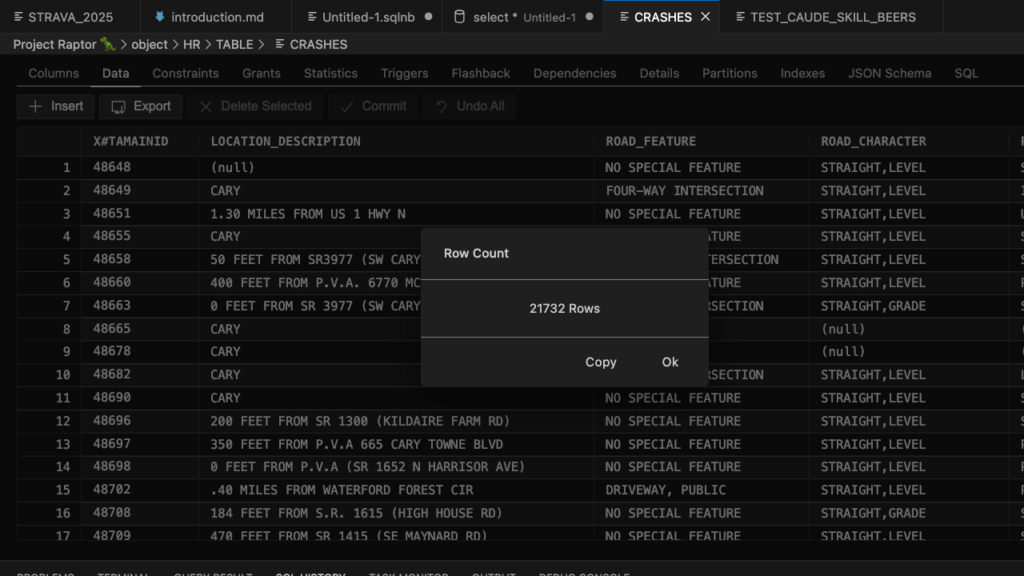
And one more, here is my City of Cary Public Data Set for traffic congestion importhandled in just 4 SQLcl MCP tool calls, one to delete the existing table, one to create the table, one to perform a load, and one to check the number of rows.
And my desk –
My expertise
---
name: oracle-csv-import
description: >
  Use this skill whenever the user wants to import a CSV (or TSV, pipe-delimited,
  or Excel) file into Oracle Database using the SQLcl MCP server. Triggers on any
  request to load, import, or ingest a file into an Oracle table — even phrased
  casually like "push this CSV to Oracle", "create a table from this data file",
  "get this into the DB", or "load this spreadsheet export into Oracle". Also use
  it when the user asks Claude to analyze a CSV before importing it, figure out
  Oracle column types, determine the right date format for an Oracle LOAD, or
  preview what table SQLcl would generate. Always invoke this skill when a data
  file and Oracle/SQLcl are mentioned together in any import-oriented context.
---

# Oracle CSV Import via SQLcl MCP

Your job is to **prepare the correct SQLcl configuration** and then execute the
import using the SQLcl MCP tools (`run-sqlcl` / `run-sql`). SQLcl's `LOAD` command
handles DDL generation, table creation, and row insertion — your role is to detect
the things it can get wrong on its own (especially date formats, delimiters, and
column sizing) and set the right options before pulling the trigger.

**Critical limitation:** SQLcl's column auto-sizing is based on a scan of the first
N rows. Even if you set `SCAN_ROWS` to a large number, SQLcl internally caps the
scan at 5,000 rows. For files where wide values appear only in later rows, auto-sizing
will produce columns that are too narrow and cause ORA-12899 errors at load time.
The safe path for any file over ~5,000 rows is to use Python to determine true max
lengths across the **entire** file, then CREATE TABLE manually before loading.

---

## Overview of the SQLcl LOAD Command

```
LOAD [TABLE] [schema.]table_name <filepath> [NEW | SHOW | SHOW_DDL | CREATE | CREATE_DDL]
```

| Mode       | What it does                                      |
|------------|---------------------------------------------------|
| *(none)*   | Load rows into an existing table                  |
| `SHOW`     | Scan file, print proposed DDL — **don't create**  |
| `CREATE`   | Scan file, create the table — don't load rows     |
| `NEW`      | Scan file, create the table, AND load all rows    |

Configuration commands (run before LOAD):

```sql
SET LOAD SCAN_ROWS 5000          -- always use 5000; SQLcl caps scan at 5000 rows regardless of higher values
SET LOAD DATE_FORMAT DD-MM-YYYY  -- Oracle NLS date format mask for DATE columns
SET LOAD TIMESTAMP_FORMAT ...    -- same for TIMESTAMP columns
SET LOAD ERRORS UNLIMITED        -- don't abort on row errors
SET LOAD COLSIZE ROUND           -- sensible column sizing (ACTUAL | ROUND | MAX)
SET LOAD CLEAN_NAMES TRANSFORM   -- auto-sanitize column names (spaces→_, prefix X if starts with digit, etc.)

SET LOADFORMAT DELIMITER |       -- if file uses pipe instead of comma
SET LOADFORMAT ENCLOSURES "      -- quote character (default already double-quote)
SET LOADFORMAT ENCODING UTF-8    -- file encoding
```

---

## Step 1 — Inspect the File

Use Python to read the raw CSV before touching the database. The goals are:
1. Detect the delimiter (comma, tab, pipe, semicolon)
2. Detect the file encoding
3. Find all DATE-like columns and determine their exact Oracle format mask
4. Flag any DD/MM vs MM/DD ambiguity that SQLcl can't resolve on its own
5. **Get true max lengths for every column across the entire file** — needed to write safe DDL

```python
import csv, re
from datetime import datetime

filepath = '/path/to/file.csv'

with open(filepath, newline='', encoding='utf-8-sig') as f:
    sample = f.read(16384)
    f.seek(0)
    dialect = csv.Sniffer().sniff(sample, delimiters=',\t|;')
    reader  = csv.DictReader(f, dialect=dialect)
    rows    = list(reader)

print(f"Delimiter: repr(dialect.delimiter)")
print(f"Rows: len(rows)")
print(f"Columns: list(rows[0].keys())")
print()

# Full column profile: max length + whether values look numeric
for col in rows[0].keys():
    vals = [r[col].strip() for r in rows if r[col].strip()]
    max_len = max(len(v) for v in vals) if vals else 0
    numeric = all(v.lstrip('-').replace('.','',1).isdigit() for v in vals[:50]) if vals else False
    print(f"  col!r:35s max_len=max_len:3d  numeric=numeric  sample=vals[0]!r")
```

Use these max lengths directly when writing the CREATE TABLE DDL in Step 3.
Round VARCHAR2 sizes up generously (e.g. max=38 → VARCHAR2(50)) to leave headroom.

---

## Step 2 — Date Format Detection

SQLcl can auto-detect common date formats, but it fails on ambiguous patterns
(e.g. `01/02/03`) and locale-sensitive month names. Always check DATE-looking
columns yourself before relying on SQLcl's scanner.

### Try these patterns in priority order

For each column, collect all non-empty values and try `datetime.strptime` with
each pattern. Use the **first** that matches all non-null values.

| Priority | Python strptime               | SET LOAD DATE_FORMAT value       | Example                  |
|----------|-------------------------------|----------------------------------|--------------------------|
| 1        | `%m/%d/%Y %I:%M:%S %p`        | `MM/DD/YYYY HH:MI:SS AM`         | 01/15/2024 02:30:00 PM   |
| 2        | `%d/%m/%Y %I:%M:%S %p`        | `DD/MM/YYYY HH:MI:SS AM`         | 15/01/2024 02:30:00 PM   |
| 3        | `%Y-%m-%d %H:%M:%S`           | `YYYY-MM-DD HH24:MI:SS`          | 2024-01-15 14:30:00      |
| 4        | `%Y-%m-%dT%H:%M:%S`           | `YYYY-MM-DD"T"HH24:MI:SS`        | 2024-01-15T14:30:00      |
| 5        | `%Y-%m-%d`                    | `YYYY-MM-DD`                     | 2024-01-15               |
| 6        | `%d-%b-%Y`                    | `DD-MON-YYYY`                    | 15-JAN-2024              |
| 7        | `%d-%b-%y`                    | `DD-MON-YY`                      | 15-JAN-24                |
| 8        | `%d/%m/%Y`                    | `DD/MM/YYYY`                     | 15/01/2024               |
| 9        | `%m/%d/%Y`                    | `MM/DD/YYYY`                     | 01/15/2024               |
| 10       | `%d/%m/%y`                    | `DD/MM/YY`                       | 15/01/24                 |
| 11       | `%m/%d/%y`                    | `MM/DD/YY`                       | 01/15/24                 |
| 12       | `%Y%m%d`                      | `YYYYMMDD`                       | 20240115                 |
| 13       | `%d-%m-%Y`                    | `DD-MM-YYYY`                     | 15-01-2024               |
| 14       | `%b %d %Y`                    | `MON DD YYYY`                    | Jan 15 2024              |

Note: `HH:MI:SS AM` uses 12-hour clock with AM/PM indicator (what you typically see in US-exported data like Chicago crime CSV exports). `HH24:MI:SS` uses 24-hour clock.

### DD/MM vs MM/DD ambiguity

If all values in a column have a day-part ≤ 12, you cannot tell automatically.
**Do not guess.** Flag this explicitly in the preview and ask the user:

> "Column `ORDER_DATE` has values like `01/02/2024` where both day and month could
> be ≤ 12. Is this DD/MM/YYYY (European) or MM/DD/YYYY (US)?"

Wait for confirmation before proceeding.

### Multiple date columns

If the file has multiple DATE columns and they have **different** format masks,
SQLcl's single `SET LOAD DATE_FORMAT` won't handle it. In that case, use a
staging-table approach:
1. Load the file as all VARCHAR2 (`SET LOAD DATE_FORMAT` omitted, or load to a
   staging table with string columns)
2. INSERT INTO the real table with explicit `TO_DATE(col, 'mask')` for each date column

---

## Step 3 — Create the Table & Load

### Default path: let LOAD NEW create the table (files ≤ 5,000 rows)

**Always use `LOAD ... NEW` to create the table** — never write a manual `CREATE TABLE`
unless the file exceeds 5,000 rows. SQLcl's CLEAN_NAMES TRANSFORM handles reserved
words, spaces, and leading-digit column names automatically.

```sql
SET LOAD SCAN_ROWS 5000
SET LOAD CLEAN_NAMES TRANSFORM
SET LOAD ERRORS UNLIMITED
SET LOAD DATE_FORMAT <detected_format>
LOAD [schema.]table_name /path/to/file.csv NEW
```

**Do not reset LOAD settings after the import.** There is no need to unset them —
the next import task will set its own configuration fresh.

### Large file path: manual CREATE TABLE + LOAD (files > 5,000 rows)

SQLcl's scan is capped at 5,000 rows internally. For files larger than that, wide
values appearing after row 5,000 will cause ORA-12899 errors because auto-sizing
missed them. The fix: use Python max lengths from Step 1 to write the DDL yourself,
then load into the pre-built table (no NEW).

Apply CLEAN_NAMES TRANSFORM naming rules by hand: spaces → `_`, reserved words get
`$` suffix (e.g. `DATE` → `DATE$`), names starting with a digit get `X#` prefix.
Round VARCHAR2 sizes up generously (e.g. max=38 → `VARCHAR2(50)`). Use bare `NUMBER`
for float/coordinate columns to avoid ORA-01438 on dirty values.

```sql
CREATE TABLE HR.MY_TABLE (
  X#ID                NUMBER(6),
  LOCATION_DESC       VARCHAR2(60),
  CONTRIBUTING_FACTOR VARCHAR2(50),   -- true max was 38, rounded up
  VEHICLE_4           VARCHAR2(35),   -- true max was 29, rounded up
  LAT                 NUMBER,         -- plain NUMBER avoids ORA-01438 on dirty coords
  LON                 NUMBER,
  TA_DATE             DATE,
  TA_TIME             VARCHAR2(15),
  CRASH_DATETIME      VARCHAR2(30)    -- ISO+tz strings load as VARCHAR2
);

SET LOAD CLEAN_NAMES TRANSFORM
SET LOAD ERRORS UNLIMITED
SET LOAD DATE_FORMAT YYYY-MM-DD
LOAD HR.MY_TABLE /path/to/file.csv   -- no NEW = load into existing table
```

**Column name matching:** DDL column names must exactly match what CLEAN_NAMES
TRANSFORM would produce from the CSV headers. Mismatches cause load failures.

### Fixing a bad load

Always **DROP the table and reload from scratch** — never attempt to patch or
re-insert missing rows. The batch rollback multiplier means many innocent rows
were rolled back alongside the bad ones, making partial repair unreliable.

```sql
DROP TABLE HR.MY_TABLE;
-- fix the DDL or settings, then CREATE TABLE + LOAD again
```

---

## Step 4 — Verify Row Count & Diagnose Errors

After the LOAD completes, SQLcl prints a summary (rows processed, rows in error).
Always verify:

```sql
SELECT COUNT(*) FROM [schema.]table_name;
```

Compare against the CSV row count from Step 1. If they differ:

**ORA-12899 (value too large):** Auto-sizing undersized a VARCHAR2. Use Python to
find the true max for the offending column, DROP the table, CREATE TABLE manually
with correct sizing, and reload.

**Batch rollback multiplier:** SQLcl loads in batches of 50. When one row in a batch
fails, the **entire batch** is rolled back. So a file with 3 truly bad rows can
produce 150 failures (3 bad rows × up to 50 rows per batch). After fixing the root
cause, always do a full DROP + reload rather than trying to patch missing rows.

**ORA-01438 (numeric precision exceeded):** A numeric column contains dirty source
data (e.g. a latitude stored as `35789790.0` instead of `35.789790`). These rows
cannot be fixed without cleaning the source. Use `NUMBER` (no precision/scale) for
coordinate columns to absorb most rogue values, but truly corrupt values will still
fail. Document these as known-bad rows — don't let them block the import.

**Count mismatch with no errors:** Check for duplicate primary keys or natural gaps
in the source ID sequence. Gaps in an ID field are normal (records deleted at source)
and do not indicate missing rows.

---

## Handling Messy CSV Files

| Problem                          | Solution                                                    |
|----------------------------------|-------------------------------------------------------------|
| Quoted fields with embedded `,`  | Already handled — SQLcl respects `ENCLOSURES "` by default  |
| Doubled quotes `""` inside field | `SET LOADFORMAT DOUBLE ON` (default is already ON)          |
| BOM in UTF-8 file                | Python's `encoding='utf-8-sig'` strips it automatically     |
| Windows line endings (`\r\n`)    | SQLcl handles standard terminators automatically            |
| Non-UTF-8 encoding               | `SET LOADFORMAT ENCODING latin1` (or cp1252)                |
| Trailing blank rows              | SQLcl skips blank rows automatically                        |
| Skip header rows > 1             | `SET LOADFORMAT SKIP 2` (skips 2 rows before header)        |
| Mixed date formats in one column | Load as VARCHAR2; convert with TO_DATE in a follow-up query |

---

## Common Error Recovery

| Oracle error  | Meaning                              | Fix                                                                 |
|---------------|--------------------------------------|---------------------------------------------------------------------|
| ORA-12899     | Value too large for column           | Auto-sizing missed wide values late in file. Use Python to get true max lengths, DROP table, CREATE TABLE manually, reload. |
| ORA-01438     | Numeric value exceeds column precision | Dirty source data in a numeric column. Use `NUMBER` (no precision) for coords/floats. Truly corrupt rows will still fail — document and accept. |
| ORA-01858     | Non-numeric char in date field       | Wrong format mask — re-examine values, try other patterns          |
| ORA-01843     | Invalid month in date                | Month-name locale mismatch — try `SET LOAD LOCALE`                 |
| ORA-01400     | Cannot insert NULL into NOT NULL     | Source has empty values; strip NOT NULL from DDL                   |
| ORA-00942     | Table or view does not exist         | Schema name wrong, or CREATE step failed                           |

---

## Quick Reference

```sql
-- DEFAULT: let LOAD NEW create the table (files ≤ 5,000 rows)
SET LOAD SCAN_ROWS 5000
SET LOAD CLEAN_NAMES TRANSFORM
SET LOAD ERRORS UNLIMITED
SET LOAD DATE_FORMAT YYYY-MM-DD HH24:MI:SS
LOAD HR.MY_TABLE /path/to/file.csv NEW
-- Do NOT reset LOAD settings after — leave them for the next task to override

-- LARGE FILES (> 5,000 rows): CREATE TABLE manually, then load
CREATE TABLE HR.MY_TABLE ( ... );  -- use Python max lengths from Step 1
SET LOAD CLEAN_NAMES TRANSFORM
SET LOAD ERRORS UNLIMITED
SET LOAD DATE_FORMAT YYYY-MM-DD
LOAD HR.MY_TABLE /path/to/file.csv

-- Fix a bad load: always DROP and reload from scratch
DROP TABLE HR.MY_TABLE;
-- correct the DDL or settings, then CREATE TABLE + LOAD again

-- Pipe-delimited, European dates:
SET LOAD SCAN_ROWS 5000
SET LOAD DATE_FORMAT DD/MM/YYYY
SET LOADFORMAT DELIMITER |
LOAD HR.MY_TABLE my_file.csv NEW
```
Berita Terkini
Berita Terbaru
Daftar Terbaru
News
Berita Terbaru
Flash News
RuangJP
Pemilu
Berita Terkini
Prediksi Bola
Togel Deposit Pulsa
Technology
Otomotif
Berita Terbaru
Daftar Judi Slot Online Terpercaya
Slot yang lagi gacor
Teknologi
Berita terkini
Berita Pemilu
Berita Teknologi
Hiburan
master Slote
Berita Terkini
Pendidikan
Resep
Jasa Backlink
One Piece Terbaru