Product managers and urban planners rarely appear in the same conversations. One develops software, the other plans cities. One works in sprints, while the other works over decades.
However, at their core, both jobs seek to address the same problem: designing systems that can be used, relied on, and continue to be used as needs evolve.
Urban planners build neighborhoods that must evolve, adapt, and persist long after the original designers are gone. Product managers face similar challenges: creating solutions that are resilient to growth, changing user behavior, organizational changes, and technical limitations.
By borrowing urban planners’ mental models, you can make better long-term decisions, avoid common mistakes in scaling, and create a product that appears holistic rather than chaotic as it grows.
In this article, we’ll look at some mental models that product managers can apply to make better long-term decisions and products.
Why product managers need systems thinking
Many product issues initially appear to be feature issues, but they are actually system issues.
Your team notices a drop in onboarding and adds another tooltip. Sales encourages more flexibility, so you add other settings. Retention stalls, so the roadmap takes on other engagement features.
This is what causes products to become bloated, inconsistent, and difficult to navigate. This is also how teams create hidden operational costs for engineering, support, design, and marketing teams.
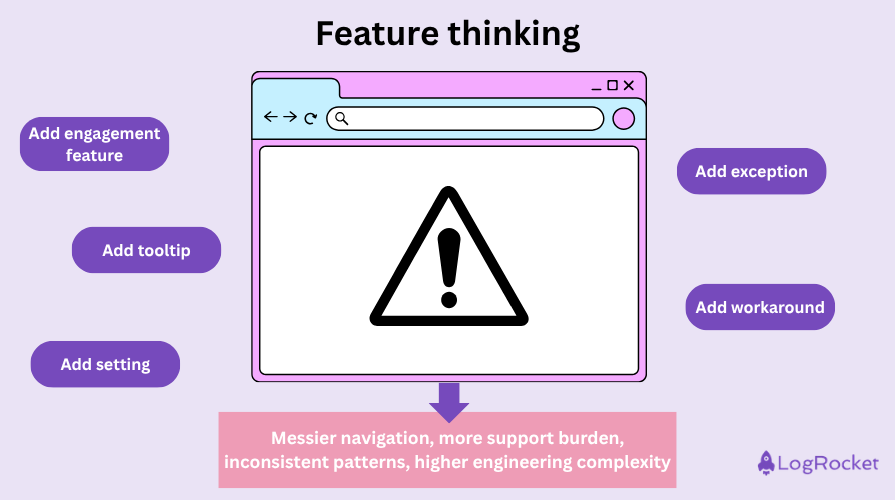
Systems thinking helps you zoom out.
Instead of asking, “Should we build it?” it asks bigger questions like: How will it impact other products? What dependencies does it create? What new behaviors will this encourage? What will make it difficult later?
City planners work this way by default. They know that a single road can change traffic flow, land use, safety, and economic activity.
Product decisions work the same way. One feature can change user expectations, support burden, data complexity, and the shape of the roadmap that follows.
Design the product as a system, not a series of features
One of the most common PM mistakes is treating each request as a stand-alone problem.
A customer requests a feature. A stakeholder drives workflow changes. A team saw a gap in the funnel and added another surface.
The job is done, but the product is starting to spread. Your navigation will soon become messy, patterns will become inconsistent, and teams will make exceptions that they will then have to support forever.
Urban planners avoid this by thinking about the neighborhood as a whole, not just individual assets.
As a product manager, you need the same mindset. A strong PM sees how users navigate the product, the flow of data across the experience, where friction occurs, and which decisions start to conflict with each other.
In practice, this often means asking whether a proposed feature strengthens the system or simply adds another layer to it. A feature can seem valuable on its own but still make the product worse as a whole. This can increase cognitive load, duplicate existing patterns, or create edge cases in other workflows.
This is also why behavior is more important than stated preferences alone. City planners don’t just rely on public meetings. They observe traffic flow, walkways, and how people use a space.
PMs should do the same with analytics, support tickets, workarounds, outages, and repeat actions. What users do often tells you more than what they say.
More great articles from LogRocket:
Balance short-term wins with long-term product health
Most product teams are under pressure to deliver short-term results. The pressure is real. Teams are measured on velocity, growth, launch, and visible progress.
The problems start when those short-term incentives become the only decision-making criteria.
City planners know that cutting corners early on can lead to long-term problems. Weak infrastructure, poor zoning, and poor traffic assumptions will not last long.
Product decisions behave the same way. Shortcuts in permissions, a weak data model, or a rushed turnaround might help the team move faster now, but they can come at a big cost down the road.
This is where the team needs a better assessment of what can be improved later and what cannot. There are problems that are easy to solve, but there are also those that are not. Trust violations, fragile architecture, fragmented UX patterns, and broken governance models typically become more costly as a product scales.
Metrics are also important here. If you only measure growth, you will continue to optimize for growth, even as the product becomes increasingly difficult to use or support. Long-term product health requires a broader view. This can include reliability, support load, quality of experience, adaptability, and user trust, not just DAU, retention, and revenue.
Build a strong foundation before growth shows its cracks
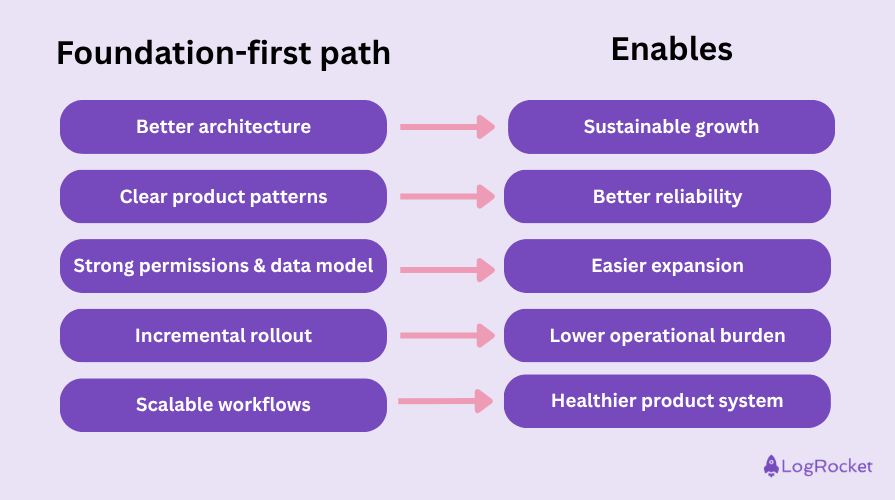
When building a city, urban planners start with the infrastructure that makes those experiences possible.
PMs should work the same way. But within product teams, infrastructure work is often harder to maintain because stakeholders don’t view it as easily as a new feature or redesign. That’s why PMs are often encouraged to prioritize visible results over fundamental work.
But in practice, APIs, data models, permission systems, internal tools, and platform reliability often determine whether a product can scale smoothly or not. A better UI can’t compensate for bad data, slow systems, fragile integrations, or workflows held together by manual operations.
This becomes clear as the product grows. A workflow that works for 100 users might fall apart if used by 100,000 users.
Support volume increases. Performance decreases. Power users stretch the product in ways the original design never anticipated. Enterprise customers bring complexity that the initial product model did not account for.
That’s why planning for scale is important before scale arrives. This is also why gradual changes are usually safer than large-scale transformations.
Cities develop through gradual development, pilot programs, and incremental improvements. Product teams benefit from the same approach through feature flags, structured rollouts, iterative UX updates, and progressive modernization.
Use constraints and tradeoffs to make better product decisions
PMs often talk about obstacles as if they are interruptions. You hear technical capacity, compliance requirements, legacy systems, legal review, organizational politics, and budget constraints framed as things that stand in the way of an ideal solution.
But constraints are part of the design problem.
Urban planners work within geography, funding, regulations, existing infrastructure, and politics from the start. They do not pretend that these forces are separate from work.
In practice, constraints often improve decision making. They force prioritization, reduce over-engineering, and push teams toward simpler, more durable solutions.
Compliance requirements can lead to better data design. Technical limitations can introduce unnecessary complexity. Organizational realities can force a more realistic path of change.
The same logic applies to stakeholders. Product work always involves competing priorities.
Users want simplicity. Sales wants flexibility. Engineering wants ease of maintenance. Leadership wants growth. The law wants security. Support wants fewer exceptions.
Your job is not to make everyone equally happy.
This is where many products lose coherence. The team continues to approve exceptions to satisfy one stakeholder at a time. Over time, products become increasingly difficult to use and develop.
Strong PMs avoid these pitfalls by making trade-offs explicit, explaining the reasons, and remaining consistent about the purpose of the product.
Design edge cases before they become mainstream
It’s easy for teams to design based on the average user. It is more difficult, but more valuable, to design the edges of the system as well.
City planners know that cities need to work for more than just the dominant users. They also need to work with children, the elderly, people with disabilities, and people whose needs do not fit into standard models. Designing only for the average case will create exceptions and weaken the system as a whole.
Products face the same risks. Teams often don’t prioritize accessibility, internationalization, minority workflows, or power user needs because those cases seem smaller in the short term. But many of these “edge cases” become much more important as products expand into new segments, markets, and use cases.
A common PM mistake is assuming that designing for the majority automatically provides sufficient benefits for everyone else. In reality, ignoring edge cases often creates friction that later shows up as adoption issues, support burden, churn, or expensive redesign work.
The advantage is that inclusive design usually helps more people than expected. Accessibility improvements often improve overall usability. Better support for non-ideal workflows can make systems more adaptable. Internationalization can open up growth opportunities that the team did not initially prioritize.
Final thoughts
Thinking in the context of urban planning is useful for PM because it shifts your attention from isolated features to the larger system that those features shape over time.
Rather than chasing features, product managers who adopt this perspective start building environments. They think in systems, respect constraints, prioritize foundation over speed, and prepare for scalability.
The best product, like the best city, is not determined by how much product is added. This is determined by how well the entire system holds together as it grows.
Featured image source: IconScout
LogRocket generates product insights that lead to meaningful action
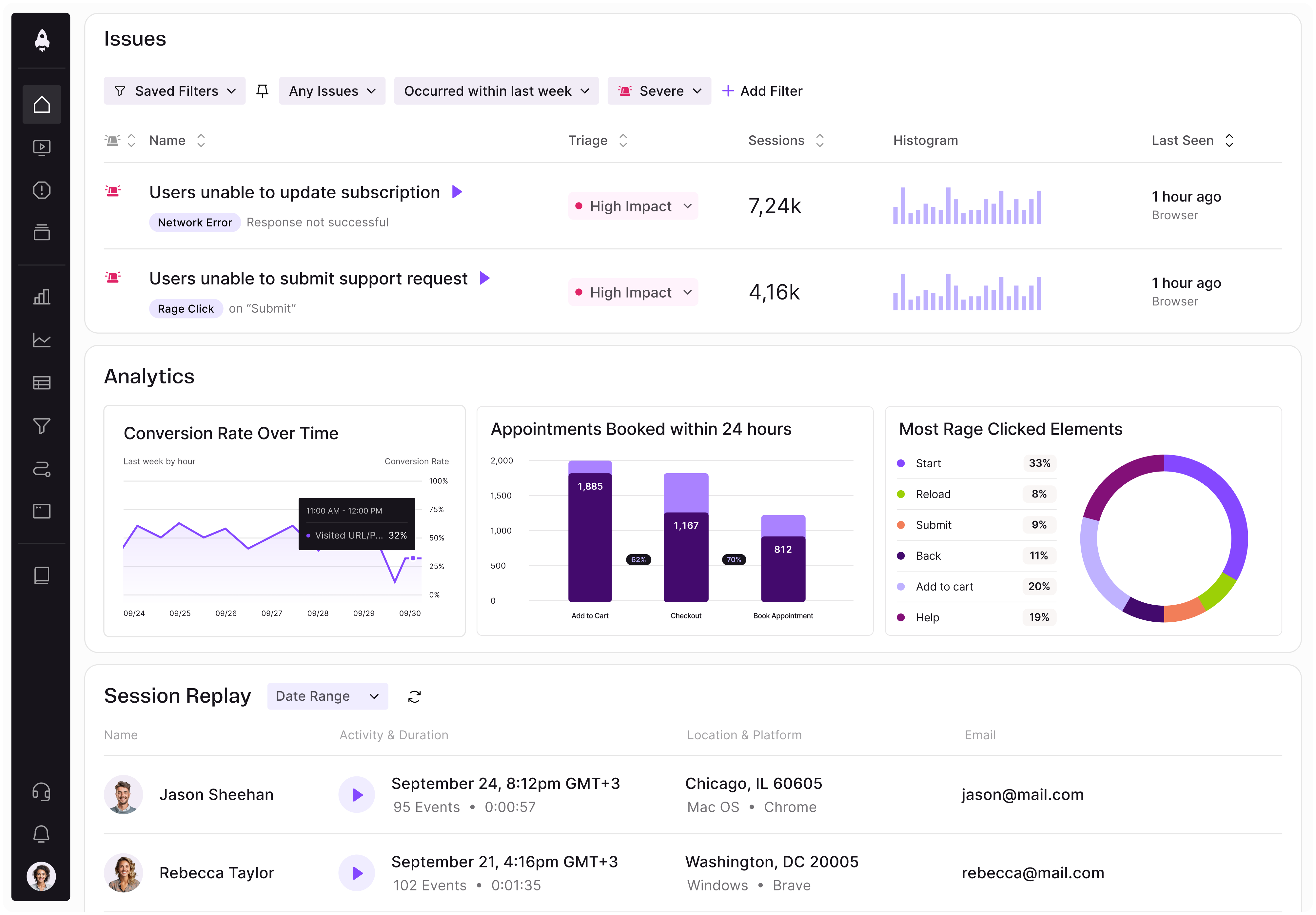
LogRocket identifies pain points in the user experience so you can make informed decisions about the product and design changes you need to make to achieve your goals.
With LogRocket, you can understand the scope of issues affecting your product and prioritize the changes that need to be made. LogRocket simplifies workflows by enabling Engineering, Product, UX, and Design teams to work from the same data as you, eliminating confusion about what needs to be done.
Get your team on the same page — try LogRocket today.
PakarPBN
A Private Blog Network (PBN) is a collection of websites that are controlled by a single individual or organization and used primarily to build backlinks to a “money site” in order to influence its ranking in search engines such as Google. The core idea behind a PBN is based on the importance of backlinks in Google’s ranking algorithm. Since Google views backlinks as signals of authority and trust, some website owners attempt to artificially create these signals through a controlled network of sites.
In a typical PBN setup, the owner acquires expired or aged domains that already have existing authority, backlinks, and history. These domains are rebuilt with new content and hosted separately, often using different IP addresses, hosting providers, themes, and ownership details to make them appear unrelated. Within the content published on these sites, links are strategically placed that point to the main website the owner wants to rank higher. By doing this, the owner attempts to pass link equity (also known as “link juice”) from the PBN sites to the target website.
The purpose of a PBN is to give the impression that the target website is naturally earning links from multiple independent sources. If done effectively, this can temporarily improve keyword rankings, increase organic visibility, and drive more traffic from search results.