We want AI, we want it now! This is not LLM hallucination or wishful thinking on the part of AI vendors. Every day I talk to companies large and small, asking for guidance on how to ‘best’ implement Agentic AI across the business for their databases.
This week Oracle enabled a new path to do this: Managed serverless MCP Server for your Oracle AI Database in the Cloud (Blog Post Announcement).

I’m busy, give me the TL;DR
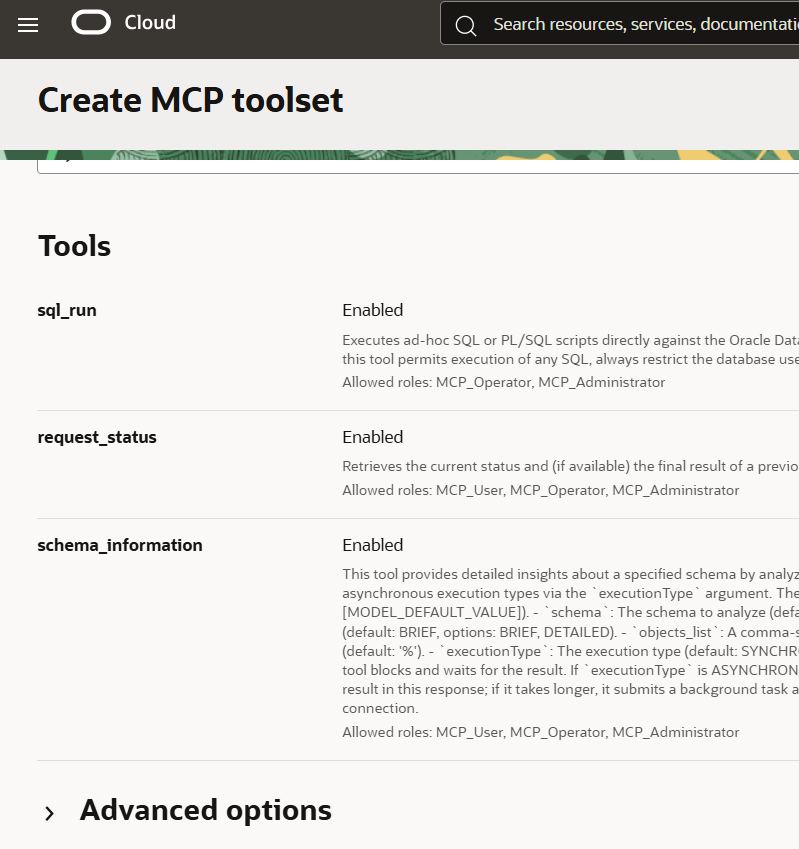
- SQLcl available as a local STDIO MCP Server, July 2025
- OCI Database Tools offers remote HTTPS MCP Server, May 2026
- built on OCI Database Tool Connection
- User authentication via OCI Identity Management Domain via OAuth2
- supports combined user accounts from Azure Entra ID, Okta, etc
- The agent is registered as a client
- Database credentials no longer need to be shared with end users!
- supports run-sql, the schema information tool introduced in SQLcl
- added support for user-defined custom Tools (your SQL or PL/SQL)
- added SQL Reports – accessed via new MCP Tools
- access to tools and reports is controlled by user group membership (roles)
Trust: Authentication/Authorization
The SQLcl STDIO local server option requires the agent end user, ALSO be a known database user. They have a set of database credentials. They can already log into the database, and run queries.
We can imagine that the number of people in an organization who can benefit from the data and information stored in their database is greater than the number of people who have direct access to the database.
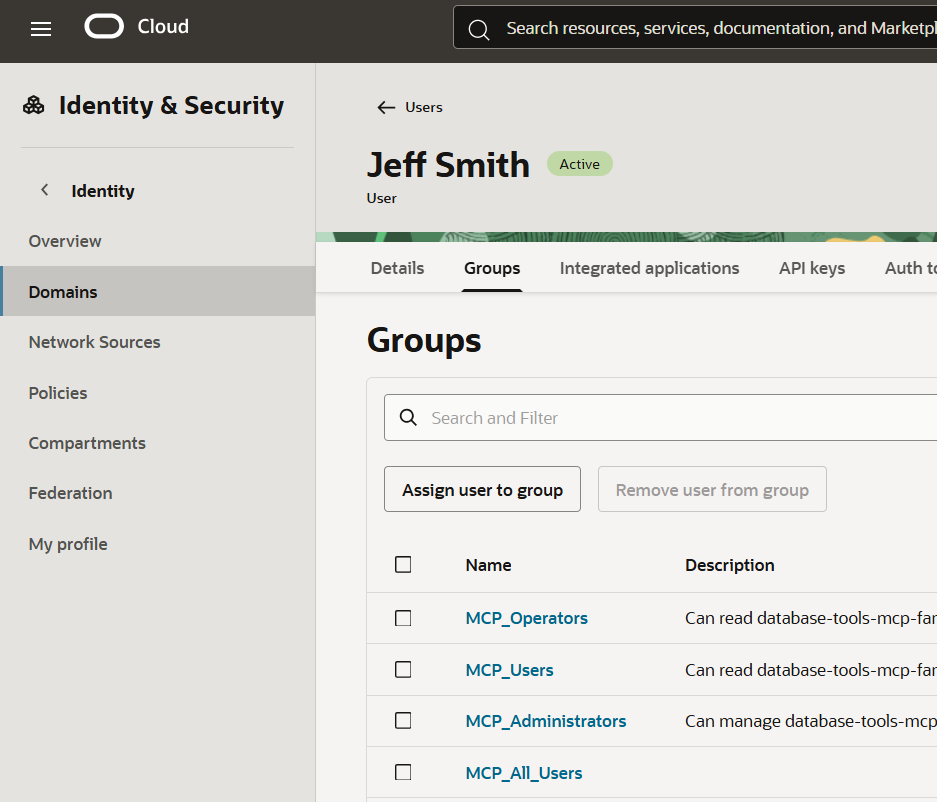
Our new deployment architecture now allows Agents to interact with our database, only after users have logged into the identity management infrastructure, and allows agents to act on their behalf (OBO). So instead of saying, “hey, I want to log in as database user HR and my database password is Oracle1234!” the user shows his company credentials, and the backend identity provider says, ‘this is Jeff Smith, he is a member of the R&D development staff, and belongs to the policy group [a, b, c, … n].”
Trust: NL2SQL is cool, but I don’t trust LLM to get SQL right
You don’t need the best frontier LLM to get ‘good’ SQL from natural language queries. I often deliberately mislead my agents, and they usually find the correct answer by generating SQL. And with proper context engineering, they can often do this in just a few interactions.
But.
If the CTO wants to know how his business is performing, and one of his staff tries to answer that question via AI chat. Are you really going to move the business based on the SQL the LLM created to sort that data?
I won’t do it. Not when your scheme is a mess. When institutional knowledge is needed to understand the data. Not if the resulting SQL is 300 rows long. Not if the person asking the question doesn’t KNOW SQL!
So what do we do?
Introducing our SQL Reports & MCP Reporting Tool
Your organization has been dealing with these data model and business logic issues for years, even decades. And somewhere you’ve created a report to generate data to satisfy these executives. It’s just that usually they are exported to Excel with pivot charts. What if the same report could be submitted directly to the Agent?

Now they can.
When I ask my agent to help me with a question about my database, the agent will see this MCP Tool and using the tool, can gain access to the report.
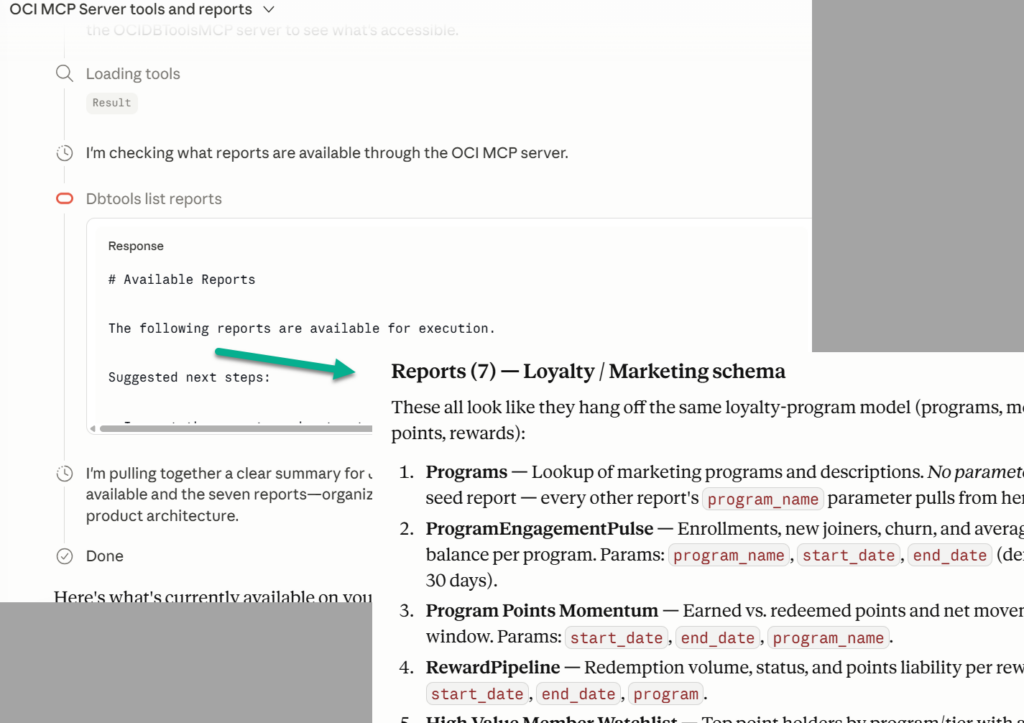
Rather than generating SQL to answer questions, LLM simply requests a report to be executed.
The reports relate to SQL queries that the business is already aware of. It has been validated over years of use. It will return the same data, every time it is run. While AI may not be deterministic, if the funnel leads to the right report, the data will be consistent!
How does an LLM know which report to choose?
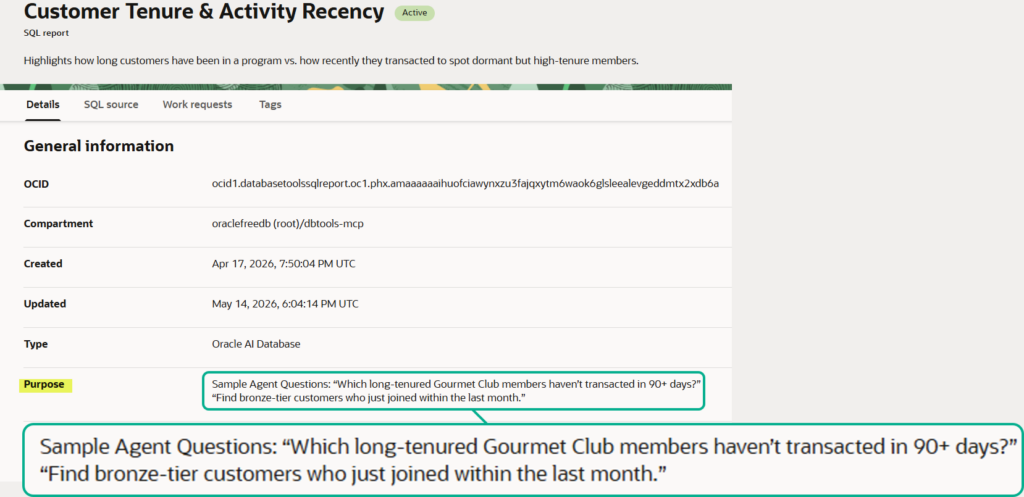
You will provide the context! For example, I have chosen to provide in advance a list of possible business questions that my specific report will address. The metadata is sent to agents, via our MCP Server and report list tools.
But Jeff, we love SQL. Our model is ‘good’, and the resulting output from NL2SQL is generally impressive.
Big. I still think you should take a look at our SQL Reports. Because the SQL behind the report can be shared with your Agents, so they can get the right SQL faster, with fewer excuses.
From Slide 11 above –
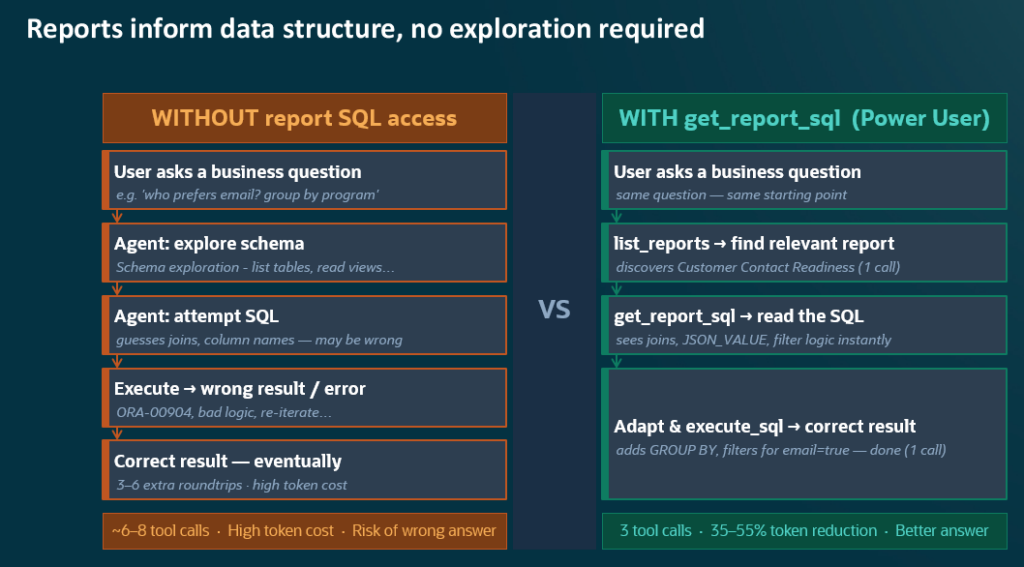
Assuming the end user is capable, they can be assigned a role that allows them to view and execute the report, but also retrieve the SQL behind the report to share with their Agent/LLM so it can generate the right SQL. And this ‘context’ is stored in a centralized place, so you don’t have to worry about quick engineering. MCP Server provides context through our OCI Database Tools resource (SQL Reports).
Oh my gosh, this is a lot, just take it slow.
If you feel this way, welcome to the new normal. I was at LangChain Interrupt this week and they shipped 6 new products in about 30 minutes of the first keynote of the day.
You have to move quickly, but you also have to be careful. Our technology makes BOTH possible.
Want to learn more? Ping me – either on LinkedIn or email (jeff.d.smith@oracle.com).
The post Trust is NOT an option: enabling AI for Oracle AI Database first appeared on ThatJeffSmith.
PakarPBN
A Private Blog Network (PBN) is a collection of websites that are controlled by a single individual or organization and used primarily to build backlinks to a “money site” in order to influence its ranking in search engines such as Google. The core idea behind a PBN is based on the importance of backlinks in Google’s ranking algorithm. Since Google views backlinks as signals of authority and trust, some website owners attempt to artificially create these signals through a controlled network of sites.
In a typical PBN setup, the owner acquires expired or aged domains that already have existing authority, backlinks, and history. These domains are rebuilt with new content and hosted separately, often using different IP addresses, hosting providers, themes, and ownership details to make them appear unrelated. Within the content published on these sites, links are strategically placed that point to the main website the owner wants to rank higher. By doing this, the owner attempts to pass link equity (also known as “link juice”) from the PBN sites to the target website.
The purpose of a PBN is to give the impression that the target website is naturally earning links from multiple independent sources. If done effectively, this can temporarily improve keyword rankings, increase organic visibility, and drive more traffic from search results.